

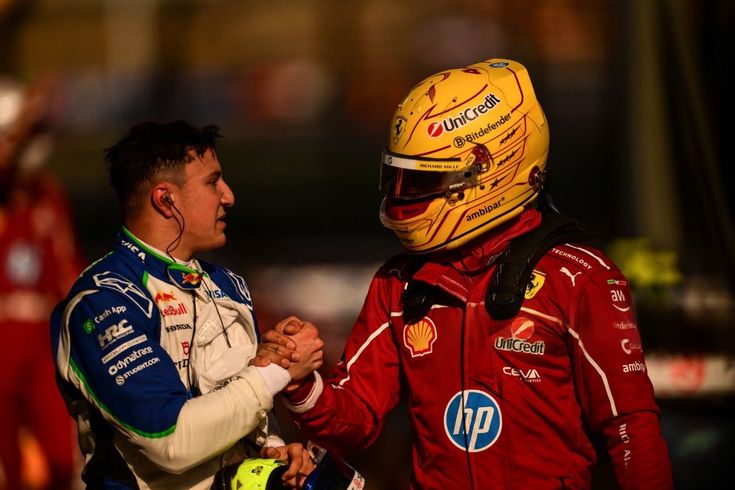
Lewis Hamilton’s legacy extends far beyond his seven world titles and countless records. His career has not only redefined Formula 1 but has also inspired a generation of young ethnic drivers who see him as proof that they, too, can succeed in a sport historically dominated by white men. Hamilton’s presence on the grid has provided representation where there was once none, giving young drivers of diverse backgrounds the confidence to pursue their dreams.
For many, the inspiration began in childhood. Japanese Formula 1 driver Yuki Tsunoda recalls: “When I was 8 years old, I went to Fuji Speedway in Japan and Lewis Hamilton was racing in McLaren. I just thought, ‘one time I want to drive with this guy and race against the best driver in the world.’” That moment of witnessing Hamilton competing at the highest level ignited Tsunoda’s ambition to one day share the track with him.
Isack Hadjar, the first Arab/Amazigh driver in Formula 1, has been even more vocal about Hamilton’s influence. He explains: “I grew up watching him. Since I was three years old, I’ve always been a fan of him and rooting for him until he won seven titles. I was really happy to actually be supporting the guy who was winning everything, and I think he’s the most complete driver out there. Since I started single-seater racing, I got interested in Formula 1 even more and it was clear to me that Lewis was the guy to beat and the reference for me, so I’ve always looked up to him as the GOAT. I really love the guy, and he inspires me so much in everything I do.”
Hadjar has often spoken of his admiration, saying: “Every time I see Lewis, I want to shake hands with him. He’s the GOAT.” On Track Limits YouTube, when asked which driver’s career inspires him most, Hadjar didn’t hesitate: “I think the answer is quite easy, just Lewis Hamilton. Lewis Hamilton’s career is just another level. The numbers are just insane! He’s the GOAT for me. He’s my favourite driver; he inspired me so much.”
Hadjar also acknowledges his own unique place in motorsport history. As the first Arab/Amazigh driver, he has spoken about how this aspect of his identity often “went under the radar.” Despite racing under the French flag, Hadjar is proud of his cultural roots and often expresses his love for his heritage. Much like Hamilton, he represents more than just racing success; he embodies the importance of diversity and cultural pride within the sport.
Hamilton’s influence doesn’t stop there. Arvid Lindblad, currently competing in Formula 2 and is Half Indian, also reflects on the impact Hamilton had on him as a young driver of colour. He shares: “Growing up, Lewis was the one I sort of looked up to the most. When I started karting, there weren’t really many people of colour and I found that to be quite a nice link. His first year in F1 was the year I was born and he was doing very well when I started getting into the sport. He was the one that I felt sort of the closest relation to in the beginning.”
Beyond his achievements on the track, Hamilton has also used his platform to speak out against racism and for the Black Lives Matter movement. In 2020, he led Formula 1 drivers in taking a knee before races, wore shirts calling for justice, and consistently challenged the sport to do more for diversity and inclusion. As the only Black driver in Formula 1 history, Hamilton’s decision to stand so firmly for equality has sent a powerful message to young ethnic drivers: that their voices matter just as much as their performances. His courage in confronting these issues has shown that being a racing driver is not only about speed and talent, but also about leading change in the wider world.
These testimonies highlight the profound impact Hamilton’s visibility, dominance, and activism have had on a new generation. Simply by being himself, a Black man excelling in Formula 1, Hamilton has broken barriers, challenged stereotypes, and opened doors for countless aspiring drivers who might have once believed motorsport was not for them.
What makes Lewis Hamilton’s story so powerful isn’t just the wins and the records, but the battles he had to fight just to get there. Growing up in Stevenage, he didn’t come from a wealthy background like many of his rivals and his dad worked multiple jobs just to keep him karting. On top of that, he faced racism from a young age, from being called slurs on the track to being doubted simply because of the colour of his skin. Even when he made it to Formula 1, the scrutiny and criticism he received often felt harsher than what other drivers faced. Yet, instead of letting it break him, Lewis turned it into fuel. He pushed harder, rose above the noise, and showed the world that he wasn’t just good enough to belong, he was destined to dominate. That resilience is a huge part of why so many young drivers from diverse backgrounds see themselves in him. Hamilton’s legacy, therefore, is not only defined by his records but also by the confidence and inspiration he has instilled in young ethnic drivers across the globe. His journey proves that representation matters, and his success, both on and off the track, continues to pave the way for a more inclusive future in Formula 1.

9 responses to “More Than a Champion: Hamilton’s Role in Empowering Young Drivers of Colour”
-
they’ll never be able to take his impact from him 🙏
LikeLike
-
i love this so much genuinely – well done sumaya!!! 💓
LikeLike
-
-
Thank you!! I’m glad you enjoyed it ❤
LikeLike
-
-
-
Thank you!! Lewis has been such an inspiration for people even outside of Formula 1 and he has also inspired me to get into journalism. I hope you can tune in for more of my work :))
LikeLike
-
-
goated writer writing abt a goated driver❤️❤️ loveddd thisss!!!
LikeLike
-
HIGHEEST FORM OF PRAISE TYSM MEGAN
LikeLike
-


 sumaya on the grid⋆.𐙚 ̊
Leave a comment